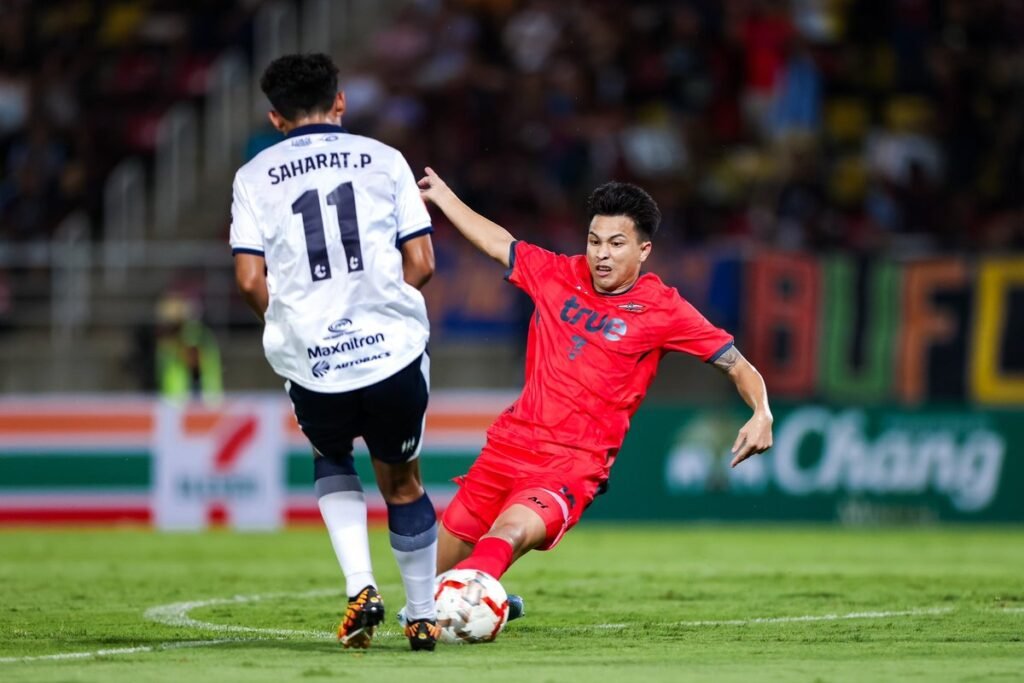

Cup competitions introduce scheduling pressure and tactical compromises that reshape league performance. In Thai League 2018/19, teams balancing domestic cups and league fixtures often displayed fluctuating form, creating patterns that can be analyzed rather than treated as random inconsistency.
Why Cup Matches Disrupt League Consistency
Cup fixtures compress schedules, reducing recovery time between matches. This leads to physical fatigue, which directly impacts pressing intensity, defensive concentration, and late-game performance.
The outcome is uneven league form. Teams competing on multiple fronts often show strong first halves but decline in later stages of matches, or rotate squads in ways that reduce cohesion. These disruptions create performance swings that are predictable when viewed through scheduling context.
Squad Rotation and Its Hidden Consequences
Rotation is often seen as a solution to fixture congestion, but it introduces new variables. Changes in lineup affect tactical familiarity, communication, and execution under pressure.
A structured breakdown of rotation impact reveals several layers:
- Key players resting leads to reduced attacking efficiency.
- Backup players may lack positional discipline within complex systems.
- Defensive units lose coordination due to altered partnerships.
- Midfield balance shifts, affecting tempo control.
- Substitutions occur earlier, limiting tactical flexibility late in games.
These factors collectively reduce performance stability. The interpretation is that rotation does not simply weaken a team—it changes how the team functions, often in ways that are not immediately visible in basic statistics.
Identifying When Fatigue Becomes Measurable
Fatigue is not always obvious, but it leaves consistent statistical signals. Recognizing these patterns allows for more accurate evaluation of team condition.
A step-by-step detection approach includes:
- Monitoring decline in second-half performance metrics.
- Tracking reduced sprint intensity and pressing actions.
- Comparing shot volume between early and late match phases.
- Observing increased defensive errors after congested schedules.
- Evaluating substitution timing and its effectiveness.
These indicators transform fatigue from a subjective concept into measurable evidence. The impact is that decision-making can account for physical decline rather than reacting only to final results.
When Cup Success Misleads League Expectations
Teams progressing deep into cup competitions often gain positive attention, but this success can distort expectations in league matches. Strong cup performances do not always translate to consistent league results.
In practice, environments linked to UFABET often show delayed adjustment to this imbalance. Teams perceived as “in form” due to cup success may be overvalued in league contexts, where fatigue and rotation reduce effectiveness. The implication is that separating competition contexts becomes essential for accurate evaluation.
Situations Where Cup Participation Strengthens Teams
Not all effects are negative. In some cases, cup matches enhance squad depth and tactical flexibility, leading to improved league performance.
Conditions where this occurs include:
- Younger players gaining experience and integrating into the system.
- Tactical variations tested in cup matches becoming effective in league play.
- Increased competition for starting positions raising overall performance.
- Momentum from positive results boosting confidence.
- Managers refining in-game adjustments through additional match scenarios.
The consequence is improved adaptability. When managed correctly, cup participation becomes a developmental tool rather than a burden.
Comparing Teams With and Without Cup Pressure
Teams not involved in cup competitions benefit from longer recovery periods and more focused preparation. This creates a contrast in performance consistency.
Conditional Performance Differences
Key differences often emerge under specific conditions:
- Non-cup teams maintain higher intensity across full matches.
- Cup-involved teams show variability depending on rotation choices.
- Tactical preparation is more detailed for teams with fewer fixtures.
- Injury rates tend to be lower for teams with reduced schedules.
These comparisons highlight how external commitments shape internal performance. The impact is that league results cannot be evaluated in isolation from scheduling context.
Translating Scheduling Pressure Into Match Decisions
Fixture congestion becomes actionable when aligned with match timing and opponent characteristics. Teams playing multiple matches within short intervals are more vulnerable against high-intensity opponents.
A noticeable pattern appears when observing pricing behavior within a casino context, where scheduling effects are not always fully reflected. Matches involving recently active cup teams may carry hidden fatigue factors, especially when facing well-rested opponents. This creates situations where performance expectations should be adjusted downward despite recent positive results.
Timing the Fade or Support Decision
The decision to oppose or support a team affected by cup competitions depends on timing. Entering too early may ignore momentum, while entering too late misses the window where fatigue peaks.
Optimal timing typically aligns with:
- Accumulated fixture congestion over multiple weeks.
- Visible decline in key performance indicators.
- Increased reliance on squad rotation.
- Opponents capable of exploiting reduced intensity.
This alignment ensures that decisions are based on converging factors rather than isolated observations.
Summary
Cup competitions in Thai League 2018/2019 introduce structural pressures that reshape league performance through fatigue, rotation, and tactical adjustment. By identifying when these factors weaken or strengthen a team, it becomes possible to interpret form more accurately. The key lies in separating competition contexts, tracking measurable indicators, and timing decisions based on cumulative effects rather than single results.